MOMENTUM RADAR
NOTHING TO
type, ever
Goldmine asks you for a phrase. Radar doesn't. Ninety digital niches are re-measured every day, so the answer is already there when you open the board — and looking costs nothing at all.
Looking is free · generating spends the studio's own credits
THE PROBLEM
A SEARCH BOX ONLY HELPS IF YOU ALREADY KNOW THE WORD
Niche research is circular: measure the right phrase and you learn something, but finding the right phrase is the actual work. So the seller types whatever comes to mind, measures it, dislikes it, and types again. Each round tests their memory, not the market.
THE FIX
AN ANSWER THAT ARRIVES WITHOUT A QUESTION
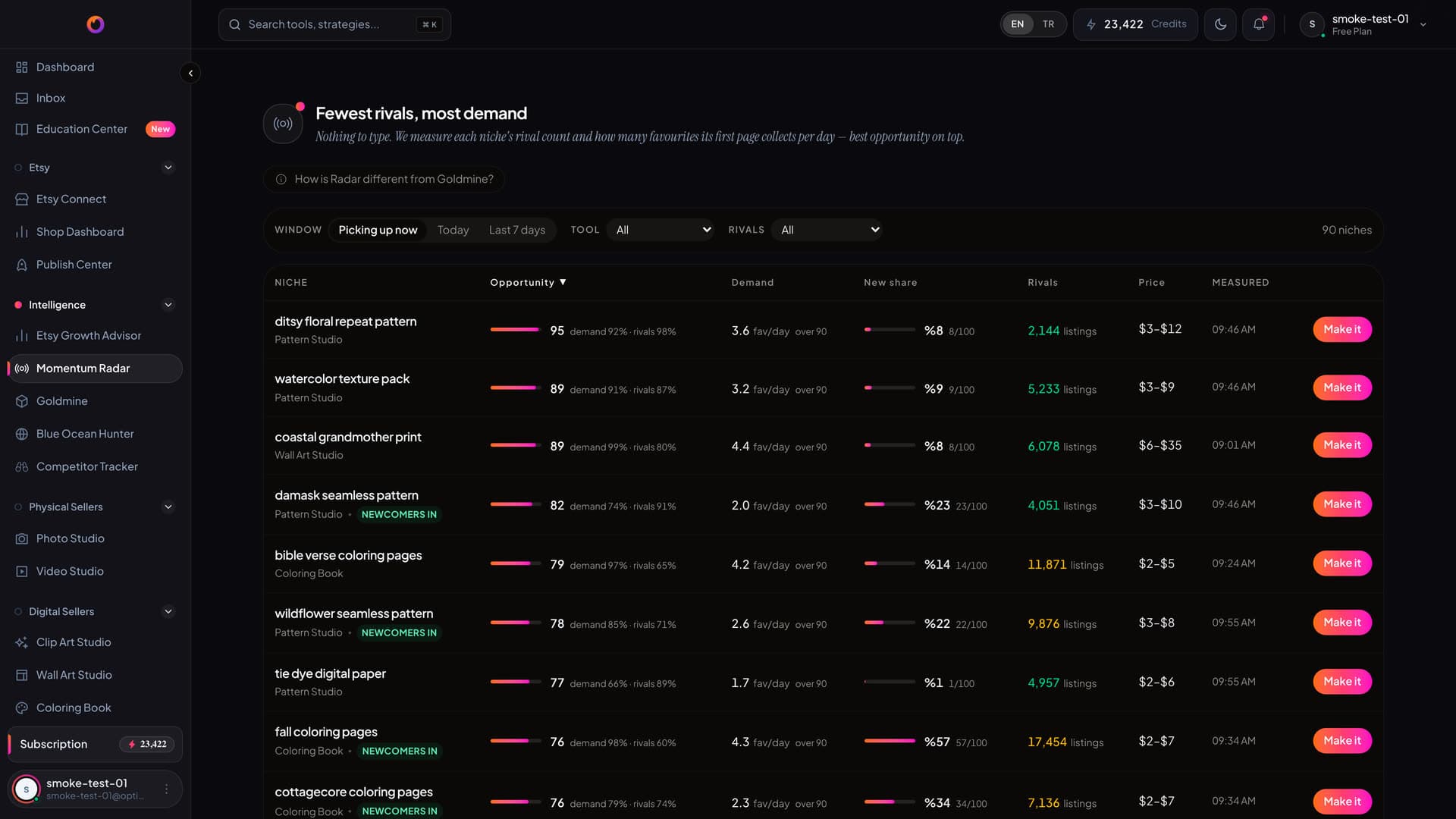
Radar doesn't ask, it measures. Every day the 90 niches on the watch list are scanned: rival count, the favourite velocity of the listings on page one, and the share of the page held by listings opened in the last 30 days. Opening the board starts no computation — yesterday's measurement is already written down.
THE COLUMNS
WHAT EVERY NUMBER ON THE BOARD MEANS
Six columns, six separate questions. None of them are estimates — every one is measured from Etsy's own search result.
Opportunity
The geometric mean of the demand and rival percentiles. Because it multiplies, a niche that scores well on one axis alone cannot reach the top — it needs both.
Demand
Favourites per day across the listings on page one. Etsy does not publish sales counts; favourite velocity is the closest demand signal a seller can actually get.
Newcomer share
How much of the relevance page belongs to listings opened in the last 30 days. High means the niche is still letting new sellers in; low means the queue belongs to older listings.
Rivals
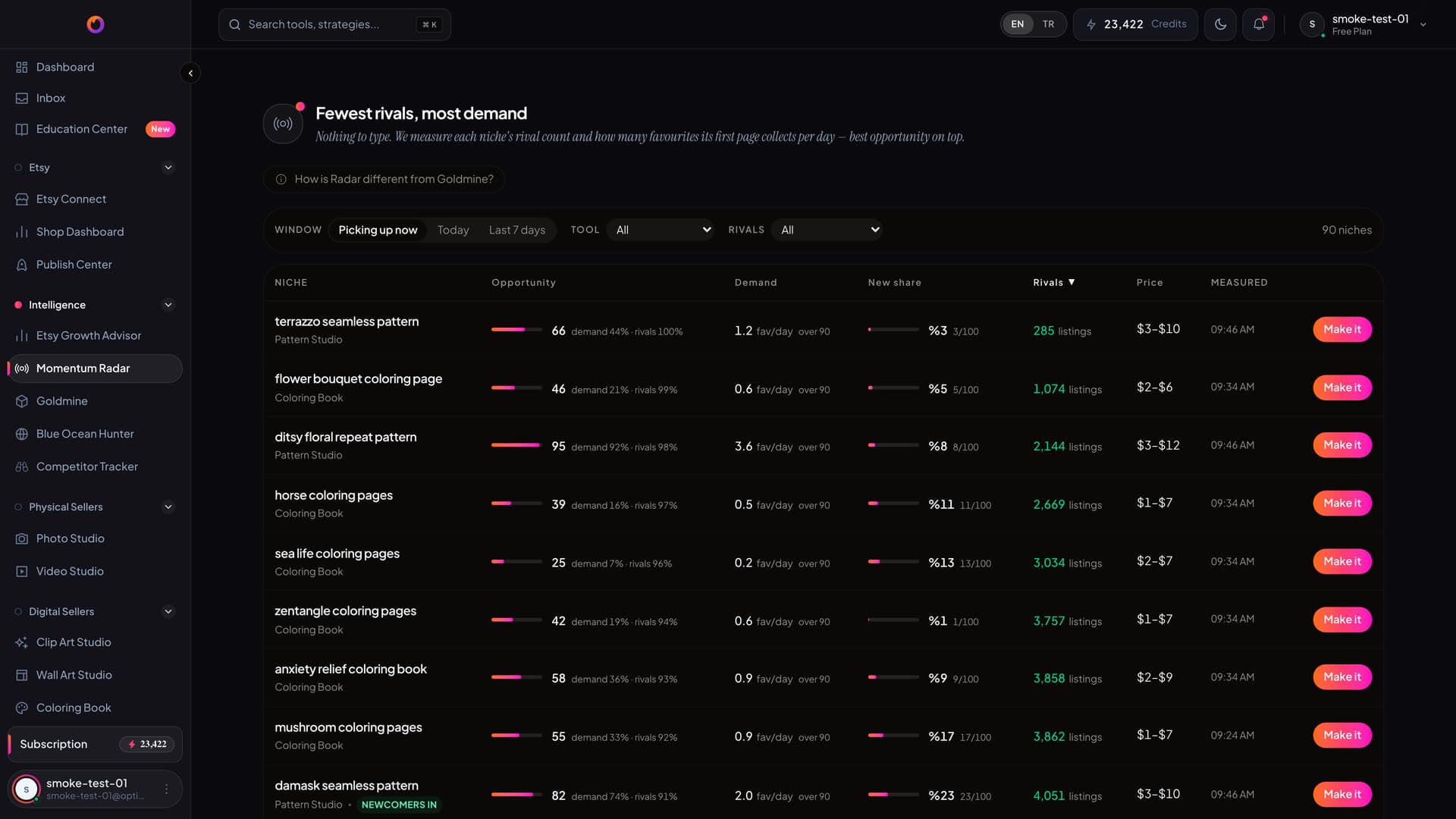
Total listings competing in the niche. The colour bands come from the measured distribution: under 7,000 is green, over 30,000 is red.
Price
The price band on page one. It tells you where to position your product before you start producing it.
Measured
When the row was last measured. A stale number stays visibly stale.
DEMO
HOW THE BOARD WORKS
in 25 seconds
The tool's own screen. Every number in the video — 90 niches, 285 rival listings — is a real measurement from that moment.
HOW IT IS MEASURED
ONE SCAN A DAY, EVERY DAY
Daily scan
All 90 niches are measured through Etsy search once a day. One request per seed — the scan is deliberately thin so it never takes quota away from the publish path.
Written to the archive
Each measurement is written to the archive, and opening the board reads that archive. Because looking is free, the cost of the surface cannot grow with its popularity.
Ranking
The opportunity score is computed from percentiles and the board is ordered best-first. Click any column header to switch to the axis you care about.
THE WATCH LIST
ONLY NICHES WE CAN ACTUALLY PRODUCE
Radar does not try to scan all of Etsy — it scans the niches you can act on. The rule is strict: if a row is on the board, that row carries a working generate button. A niche nobody here can produce would be a row that wastes the seller's attention.
- 30 niches · Wall Art Studio
- 30 niches · Coloring Book
- 30 niches · Pattern Studio
- Open-to-newcomers badge: newcomer share above 18% AND fewer than 20,000 rivals — it flags 11 of the 90 niches
COMMON QUESTIONS
How is this different from Goldmine?
Goldmine measures any phrase you type — you can ask about whatever word you like. Radar asks nothing; it measures a pre-selected watch list every day and ranks the result. One is a tool for asking questions, the other is a board where the answer is already waiting.
Does looking at the board cost credits?
No. Opening the board reads from the archive and makes no Etsy call at all. Credits are only spent when you press generate on a row and actually produce something — at that studio's own rate.
How fresh are the numbers?
Every row prints its own measurement time. The scan runs once a day, so what you see is at most a day old.
Who picks the niches on the list?
The watch list is hand-written, and we know a hand-written list goes stale. That is why the daily scan records how many seeds produced a usable sample: dead phrases do not disappear quietly, they show up as falling yield.
Where do the thresholds come from?
From measurement. The badge thresholds and colour bands were derived by scanning all 90 seeds and reading the distribution. The first version used numbers that merely looked reasonable, and they were dead on arrival: a 1,000-rival limit passed exactly one niche out of 90.
STOP DECIDING
what to search for
Open the board, find the least crowded niche, produce it. Looking is free — you don't have to pay before you can decide.
No credit card · looking at the board costs no credits