

Free Etsy tool · no sign-up
Dimensional Weight Calculator
Enter your box's outside size and what it weighs. You get the weight USPS, UPS and FedEx bill you for, whether the box or the scale sets it, and the smallest cut that brings it down. Switch to cm and kg for desi and international express.
Measure the outside of the box at its longest points, not the item inside.
Quick examples
Everything is calculated in your browser. Nothing you type is sent anywhere, and no sign-up is needed.
Result
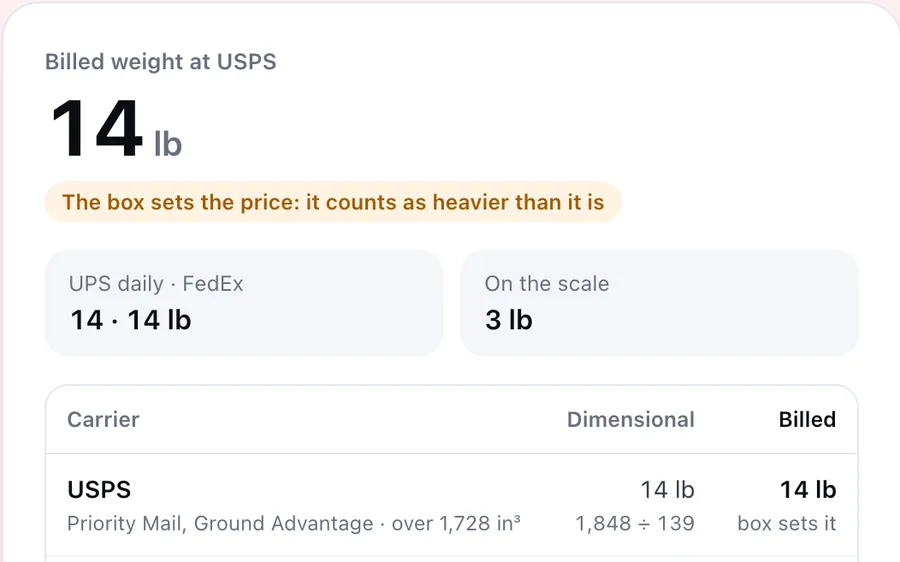
Billed weight at USPS: 14 lb
Billed weight at USPS
14lb
The box sets the price: it counts as heavier than it is- UPS daily · FedEx
- 14 · 14 lb
- On the scale
- 3 lb
| Carrier | Dimensional | Billed |
|---|---|---|
| USPSPriority Mail, Ground Advantage · over 1,728 in³ | 14 lb1,848 ÷ 139 | 14 lbbox sets it |
| UPS daily ratesAccount and online rates | 14 lb1,848 ÷ 139 | 14 lbbox sets it |
| UPS retailAt a UPS Store or counter | 12 lb1,848 ÷ 166 | 12 lbbox sets it |
| FedExUS and international | 14 lb1,848 ÷ 139 | 14 lbbox sets it |
Cut the length from 14 to 13 in: 14 → 3 lb
At USPS that takes the box to one cubic foot (1,728 in³) or less, so dimensional weight stops applying and the scale decides. If the item still fits, it saves on every order.
Example box. Type your own measurements.
Divisors and rounding checked against each carrier on November 2, 2026. Sources
In short
Dimensional weight is the box's length × width × height divided by the carrier's divisor. You're billed for whichever is higher, that or the scale weight, each rounded up. At USPS a 14 × 12 × 11 in box that weighs 3 lb is billed as 14 lb: it is larger than one cubic foot, and 1,848 ÷ 139 rounds up to that.
Calculate
See what your box weighs to the carrier
The billed weight, not just the scale
Carriers bill whichever is higher: what the parcel weighs or what the box counts as. The calculator rounds both the way each carrier does and tells you which one sets the price.
USPS's one cubic foot line
USPS only applies dimensional weight above 1,728 cubic inches. A box just over that line can be billed at several times its scale weight; one inch less and the scale decides again.
Then price the shipping in
Take your carrier's rate for that weight to the Free Shipping Price Calculator to see the item price that keeps your profit. Every fee on that price is in the Profit Calculator.
Next step
Check the new price against the market
See whether a price with shipping still fits
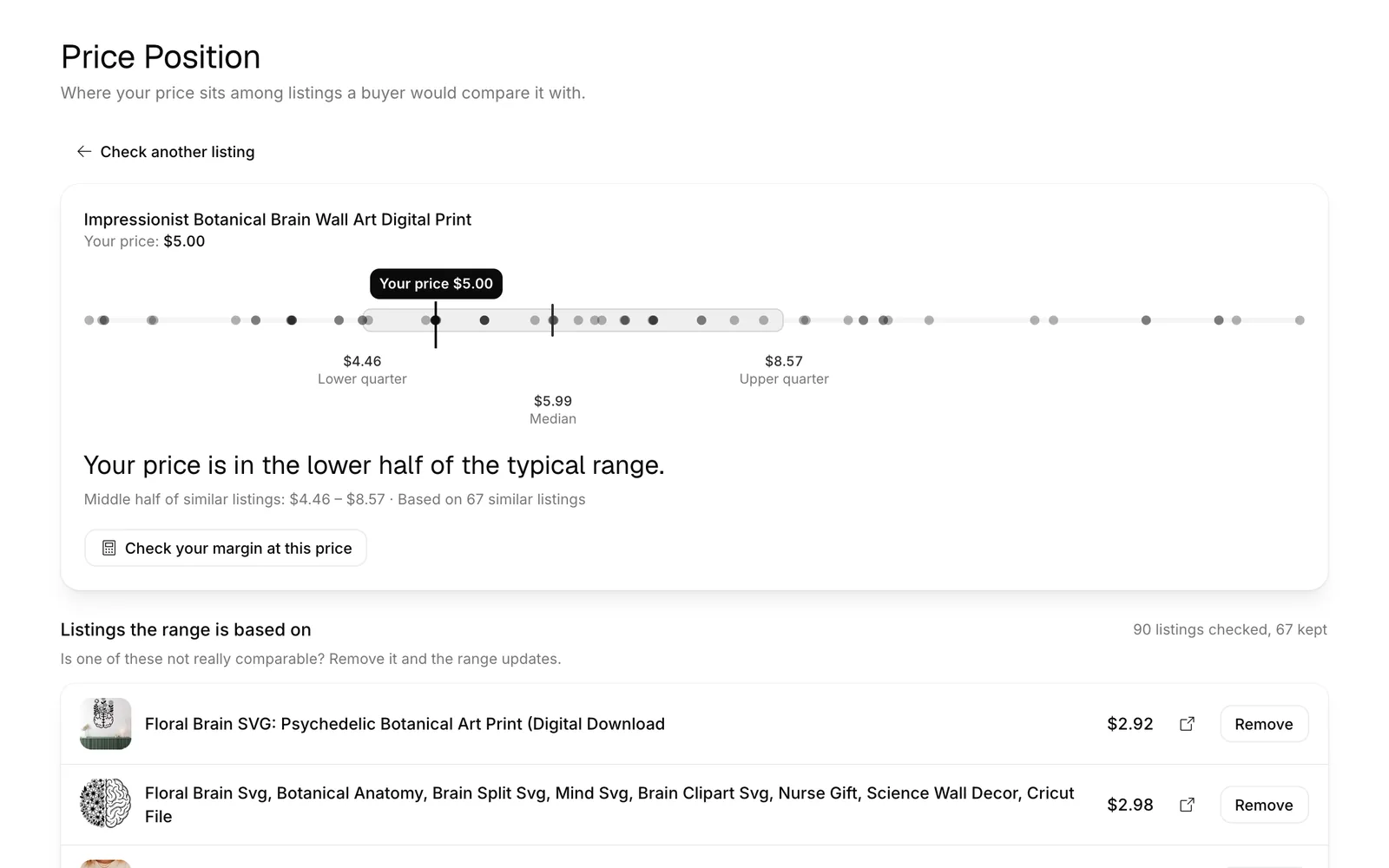
Price Position places your price among the listings buyers compare it with and shows the typical range and the median, so a heavy box built into the price doesn't push you out of range.
Watch rival prices change
Competitor Tracker follows rival Etsy shops every night, including price changes on their most-favorited listings. Before you reprice, read how to analyze competitor pricing.
Find niches with room on price
Goldmine scans Etsy categories and ranks rising niches by growth and competition, so you can look for room before you settle on a price.
The whole sale
From box weight to the price you list
Free shipping without losing profit
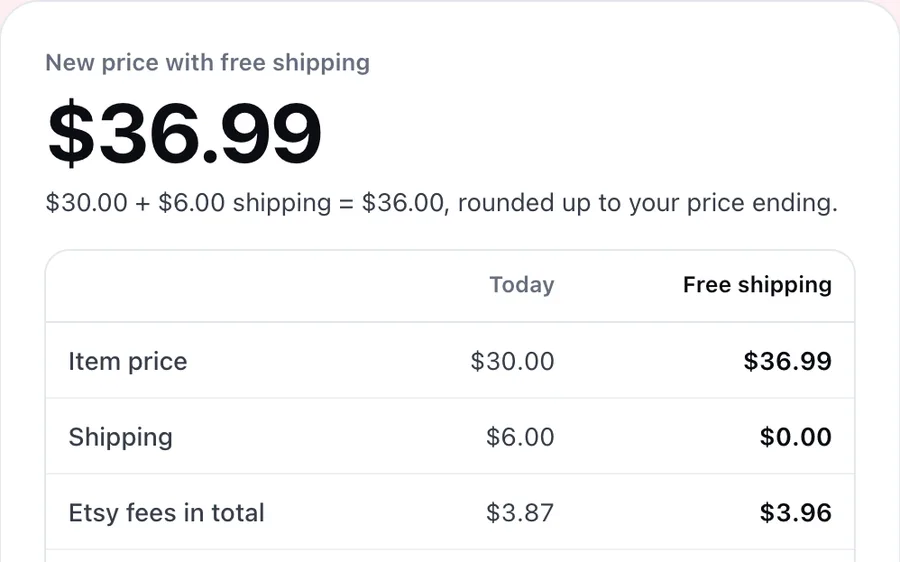
The Free Shipping Price Calculator moves what you charge for shipping into the item price and checks Etsy's $35 US free shipping guarantee.
Every fee on one sale
The Profit Calculator lists the transaction fee, payment processing and the listing fee for your payment country, and the table of Etsy fees by country compares them.
Orders that come from ads
The Offsite Ads fee is charged on price plus shipping too. The Offsite Ads Fee Calculator shows what an ad order leaves you.
Free tools and the Optimsy dashboard
Everything your shipping and pricing needs
The free tools work without an account; the rest live in the Optimsy dashboard.
- Listing CheckerFreeCheck your title and 13 tags against Etsy's rules, line by line.
- Tag GeneratorFreeDescribe your product in a sentence; get 13 tags that fit Etsy's rules.
- Title GeneratorFreeOne main title and two alternatives, key words first.
- Profit CalculatorFreeTake off Etsy's fees and see what you keep from every sale.
- Print Size CalculatorFreeSee which print sizes your image covers at 300 DPI.
- Aspect Ratio CalculatorFreeSee a size's ratio and whether it fits Etsy, print and Pinterest.
- Image Size CheckerFreeCheck a banner, shop icon or listing photo against Etsy's sizes.
- Shop AuditFreeYour shop's biggest gaps, with the report sent to your inbox.
- Coloring Page GeneratorFreeDescribe your scene and get a coloring page with closed outlines for the age group.
- KDP Cover CalculatorFreeSpine width, bleed and a 300 DPI cover template for KDP paperbacks.
- Offsite Ads Fee CalculatorFreeSee what an Offsite Ads order costs you and when it stops paying.
- Free Shipping Price CalculatorFreeBuild shipping into your price without losing profit, and check the $35 US guarantee.
- SEO ExpertTitle, 13 tags and description; each tag shown with its live rival count.
- Listing ScorecardCompare your listing with the top 100 in its search and approve the fix.In the dashboard: My Shop, next to each listing
- Keyword ExplorerMeasure a keyword's rival listings and daily favorites.In the dashboard: inside a Goldmine scan
- Photo Studio12 Etsy-ready shots from a single product photo.
- Price PositionCompare your price with the listings buyers weigh it against.In the dashboard: My Shop, next to each listing
- GoldmineScan categories and rank rising niches by growth.
- Coloring BookA book of up to 20 pages, a cover and the KDP print PDF.
How dimensional weight is calculated
Every carrier multiplies the box's three sides and divides by its own divisor. The result is compared with the scale weight, both are rounded up, and you pay for the higher one. What changes from carrier to carrier is the divisor and how the sides and the result are rounded.
- Measure the outside of the box: length, width and height at their longest points.
- USPS: round each side up to a whole inch. Only above 1,728 cubic inches, divide by 139 and round up to the next pound.
- UPS: round each side up, then divide by 139 on daily rates or 166 at retail. FedEx: round each side to the nearest inch and divide by 139.
- International express (cm and kg): divide by 5000 and round up in 0.5 kg steps. Turkish domestic desi: divide by 3000.
- Billed weight = the higher of dimensional weight and scale weight, both rounded up.
Example: a 14 × 12 × 11 in pillow box that weighs 3 lb. It is 1,848 cubic inches, over USPS's one cubic foot line, so 1,848 ÷ 139 = 13.29 rounds up and the box is billed as 14 lb. Cut the length to 13 in and it drops under the line: the bill falls to 3 lb, the scale weight.
Divisors and rounding by carrier
These are the rules each carrier publishes for standard boxes. A contract or a shipping platform can give you different terms, so check your own account if it does.
| Carrier | Divisor | Sides | Result |
|---|---|---|---|
| Turkey domestic | ÷ 3000 | In cm, not rounded | Usually up to the next whole desi, compared one to one with kg |
| International express | ÷ 5000 | In cm, not rounded | Up to the next 0.5 kg |
| USPS | ÷ 139 | Each side up to a whole inch; applies only above 1,728 in³ | Up to the next pound |
| UPS daily rates | ÷ 139 | Each side up to a whole inch | Up to the next pound |
| UPS retail | ÷ 166 | Each side up to a whole inch | Up to the next pound |
| FedEx | ÷ 139 | Each side to the nearest inch | Up to the next pound |
The calculator gives weights, not prices. Rates depend on your carrier, service, zone and account, and they change; take the billed weight to your carrier's rate table or your label platform.
Once you have a rate, the Free Shipping Price Calculator builds it into your price without losing profit, and the Profit Calculator shows every Etsy fee on the new price.
Divisors and rounding from each carrier's own pages, last checked November 2, 2026.
How it works
Measure the box
Type the outside length, width and height of the box you ship in, and what the packed parcel weighs on the scale.
Pick your units
Use inches and pounds for USPS, UPS and FedEx, or centimeters and kilograms for desi and international express.
Read the billed weight
See what each carrier bills, whether the box or the scale sets it, and the smallest single cut that lowers it.
Frequently asked questions
What is dimensional weight?
It's the weight a carrier assigns to a parcel based on its size: length × width × height divided by the carrier's divisor. Carriers compare it with what the parcel actually weighs and bill the higher of the two, so a large, light box can cost as much as a much heavier one.
How do I calculate dimensional weight for USPS?
Round each side up to a whole inch and multiply them. If the result is over 1,728 cubic inches, divide by 139 and round up to the next pound; that's the dimensional weight. At or under 1,728 cubic inches USPS charges by scale weight only. The divisor has been 139 since July 12, 2026.
What divisor do UPS and FedEx use?
Both use 139 for daily and account rates. UPS uses 166 for retail rates at a UPS Store or counter. UPS rounds each side up to a whole inch, while FedEx rounds each side to the nearest inch, so the same box can come out slightly different at the two carriers.
Why am I charged more than my parcel weighs?
Because the box's dimensional weight is higher than its scale weight, and carriers bill the higher one. It's common with pillows, lampshades, framed prints and anything light that ships in a big box. The calculator shows when the box sets the price and how much smaller it would need to be.
Should I measure the item or the box?
The box, from the outside, at its longest points, including any bulge from padding. Carriers measure the parcel they receive, not the product inside. If you reuse boxes, measure the one you actually ship in: a box only an inch bigger can change the billed weight by several pounds at USPS.
Does the calculator show shipping prices?
No. Rates depend on the carrier, the service, the destination zone and your account, and platforms like Etsy shipping labels or Pirate Ship have their own discounts. The calculator gives the billed weight, which is what every rate table starts from. Then build the rate into your price with the Free Shipping Price Calculator.
What about tubes and other non-rectangular parcels?
This calculator treats every parcel as a rectangular box. USPS multiplies the sides of a non-rectangular parcel by an adjustment factor of 0.785 before dividing, and other carriers have their own rules for tubes and irregular shapes. Check your carrier's page if you ship rolled prints or posters in tubes.
No sign-up needed
Dimensional Weight Calculator
Enter your box's outside size and what it weighs. You get the weight USPS, UPS and FedEx bill you for, whether the box or the scale sets it, and the smallest cut that brings it down. Switch to cm and kg for desi and international express.
No card needed · 25 credits on a new account